stuxlogo

Step by step user guide for STUX GNU/Linux (index)

STUX iso file can be created in 2 ways:
  1. Easy STUX remastering

      This is the easiest way to create a bootable STUX iso file: the iso file will be created using the current running system root directory; every file present when creating iso file, will be copied in iso file: this means that you can totally re-configure your system as you wish (install/remove packages, configurations, files, ...) and then, when tested if everything works well, create the iso file. Warning that if you have configured some hardware before create iso file, the resulting iso file will probably work only on the same hardware: do not configure any hardware if you wish to maintain hardware auto-detection: if

      ALL files currently in system will be installed on new iso file, including logs in /var/log and various history files: if you plan to redistribuite the iso file, you have to manually clean all logs/history files before start remastering.

      Start remastering STUX:
      STUX Control Center -> Live CD -> Remaster STUX Live CD iso file
      a window like this will appear:
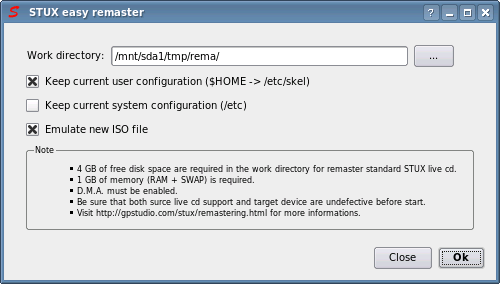


      Choose a temporary writable directory: there must be at least 4 GB of free disk space in order to build a 700 MB iso file on an ext2, ext3, reiser, ... filesystem; FAT and NTFS filesystems are not supported.

      If you have low RAM memory you have to setup swap space: 1 GB of memory (RAM + swap) is required for a 700 MB iso file.

      You can easy remaster STUX Live CD only from Live CD environment. Because of remastering is a long time process, in order to get best time performances you are suggested to run STUX Live CD environment from hard disk instead of from cdrom drive (see Install STUX compressed image on IDE or USB devices) and possibly choose a work directory on a disk drive different than the one used to install the compressed image.

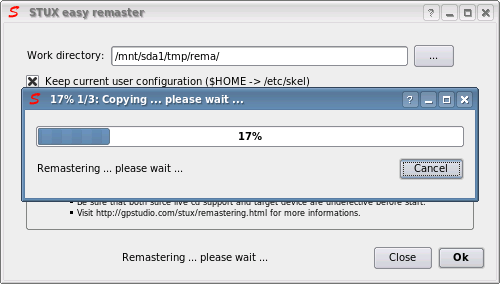
      When ready, click the Ok button to start.

      When finished, the iso file could be burned on a CDROM or emulated.


  2. Liso

      Liso README file 
      
      
      Requirements:
      =============
      
      - A temporary writable directory with at least 4 GB free to build a 700 MB iso 
        file
      - 1 GB of RAM + SWAP to build a 700 MB iso file
      
      
      Overview:
      =========
      
      Liso is the set of programs and data used to build STUX Linux.
      
      The Liso program is installed in all STUX distributions in directory
      /usr/local/stux-utils/liso-*
      
      By default, if you have configured the working directory in /etc/liso.conf (see 
      variable W_DIR later), you can execute commands:
      
      $ cd /usr/local/stux-utils/liso-*
      $ sudo ./liso
      
      if you are connected to the internet, you will get, after some time, the
      rebuild of the iso file of the current STUX system, updated with the latest
      Slackware packages, ready to be burned on CD ROM.
      
      The first time you execute Liso, it will take lot of time for downaload 
      updated packages from Slackware repository: it could take hours, depending on 
      your connection speed. Once downloaded updated packages, you can turn off the 
      auto-update feature (variable UPDATE_TO_CURRENT=0 in /etc/liso.conf, see later)
      until you will want update to Slackware-current again.
      
      Probably you will also want to add/remove/upgrade packages to the resulting iso 
      file: in this case you have to configure Liso, read the following chapter 
      'How to select packages to install'.
      
      New Slackware packages will be downloaded from a Slackware-current mirror in 
      directory ./apps.current: if you start with zero packages, this operation will 
      take lot of time for dowload all packages, and will take lot of disk space in 
      the ./apps.current directory. If Liso is running from the Live CD environment, 
      it would be better that you link the ./apps.current directory to a persistent 
      directory with enough disk space.
      
      
      Configuration:
      ==============
      
      Liso reads its configuration from file /etc/liso.conf.
      
      The following variables should be configured:
      
      1) Variable W_DIR: the working directory:
         specify a working directory (variable W_DIR in liso.conf): W_DIR must have
         at least 4GB free to build a 700 MB iso file and must reside on a Linux 
         filesystem (ext2, ext3, reiserfs, no fat or ntfs).
         Resulting iso file will be located in W_DIR/stux.iso.
         This directory is cleaned when Liso start.
      
      2) Variable UPDATE_TO_CURRENT: update packages to Slackware current.
         Set to 1 to connecto to internet repository to check if new packages
         version are available. 
         The first time you use Liso, you shoud have set UPDATE_TO_CURRENT=1 in 
         order to syncronize your local package repository in ./apps.current 
         with Slackware-current. If you need to download all Slackware packages,
         the operation could take hours to complete.
         Once downloaded all updated packages, you can set UPDATE_TO_CURRENT=0
         until you don't decide to update packages again.
      
      3) Variable DEFAULT_REPO: the default internet Slackware repository.
         Use the Slackware mirror nearest to you. By default is:
         ftp://ftp.slackware.at/slackware-current/slackware , the Austrian 
         Slackware official mirror.
      
      4) Variable UPDATE_STUX_CONF: if setted to 1, Liso will
         a) run updatedb command in the new root directory
         b) search media files in the new root directory and update STUX media 
            playlists.
         c) update packages list from swaret repositories.
         These operations could take several time to perform, so should be used 
         only when building the definitive iso file. 
      
      
      How to select packages to install:
      ==================================
      
      When Liso starts, it builds the list of packages to install.
      
      1) The directory ./tagfiles contains the Slackware tagfiles: packages marked
         as ADD will be installed. Slackware packages marked as ADD in tagfiles are
         expected to be located in the ./apps.current directory. To download updated
         versions of Slackware packages from the internet repository specified by 
         variable DEFAULT_REPO in /etc/liso.conf, set variable UPDATE_TO_CURRENT=1
         in /etc/liso.conf; once your packages has been updated to the current 
         Slackware distribution, you can set the variable UPDATE_TO_CURRENT=0 until 
         you want to update to Slackware current again.
      
      2) All packages found in directory ./apps will be installed, even if they are
         not listed in tagfiles. Copy in the ./apps directory all extra packages that 
         you want to install in the iso file but that are not present in tagfiles.
      
      3) Additional kernel modules have to be found packages as Slackware package in 
         the ./more_modules directory.
      
      4) All packages listed in files ./stux-common-packages.conf will be installed in 
         the iso file, copying files from the current system installation. This means
         that you don't need to have or download packages listed in file 
         ./stux-common-packages.conf in order to install them in iso file.
         By default, file ./stux-common-packages.conf contains all packages installed
         in STUX that are not present in Slackware-current repository.
         File ./stux-common-packages.conf will be updated in the Liso installation of 
         the resulting iso file and will include all extra packages found in 
         directory ./apps.
         Packages listed in file ./stux-common-packages.conf must have an 
         installation log file in directory /var/log/packages/, created by the 
         installpkg program. 
      
      5) All packages listed in file ./stux-common-modules.conf will be installed in 
         the iso file, copying files from the current system installation. This means
         that you don't need to have or download packages listed in file
         ./stux-common-modules.conf in order to install them in iso file. 
         By default, file ./stux-common-modules.conf contains all modules installed
         in STUX that are not supported by Knoppix kernel (NVidia, acx).
         File ./stux-common-modules.conf will be updated in the Liso installation of 
         the resulting iso file and will include all extra packages found in 
         directory ./more_modules.
         Packages listed in file ./stux-common-modules.conf must have an
         installation log file in directory /var/log/packages/, created by the
         installpkg program.
      
      6) All files in the ./rootstux directory will be installed: for example, if the 
         file ./rootstux/etc/passwd exists, this will be installed in /etc/passwd in 
         the resulting iso file.
      
      To change boot picture, edit picture file ./kernel/boot.ppm.
      Kernel and boot configuration files are in the ./kernel/boot/isolinux/ directory.
      
      
      Web forum:
      ==========
      
      http://gpstudio.com/redir/redirect.php?arg=forum&page=remaster
      
      
    For more specific informations post a question to the forum.

    There is a public forum about this.


stuxlogo